Showing posts with label Wine. Show all posts

Monday, February 8, 2010

If it's good enough for Louis Vuitton, it's worth a try.

You would think it’s impossible for a foodie to not know about what is quite possibly the world capital of gastronomy. Unfortunately for me, I only learned about Lyon, with its internationally-renowned chefs like Paul Bocuse and its more than 40 outdoor food markets, after I came back from trip to France.

I had meticulously planned our trip, hitting Paris of course not for the food so much as the experience of being in the city of lights. Then it was off to Bordeaux. Had I known about Lyon, I might have skipped Bordeaux, since they are on opposite sides of France. However, I’m so glad I didn’t. The laid back atmosphere of the city, the quaint outskirts filled with farmers and the astonishing vineyards of the region were the highlight of my trip, even after seeing the Eiffel tower twinkling at night, which I have to admit is quite magical.

Bordeaux has been maligned, in my view, in many ways. Most people don’t realize that the area has numerous appellations of wine, 57 to be exact. Appellations such as ‘Pauillac,’ ‘Medoc,’ ‘Graves,’ ‘St. Emillion’ and ‘Sauternes’ are all from the Bordeaux area. The wines labelled “Bordeaux” are really just what is left from the crops after the winemakers have made their limit for the appellation on their property. The amount each “Chateau” can produce is strictly controlled, so any excess grapes cannot be sold under the appellation of that specific area. Instead, they are labelled Bordeaux. Since they don’t have the distinction of an appellation, they are sold a little cheaper, but don’t overlook this region as a wine destination, because it is worthy of a stop.

While in Ontario everyone is raving over ice wine right now, Sauternes, which I like to to think of the great-grandfather of icewine comes from the Bordeaux region. If you’ve ever tried a Sauternes you know it’s a dessert wine. But do you know how it’s made?
Primarily made of Semillion grapes, it is a blended wine that includes Sauvignon Blanc grapes and sometimes is blessed with a little Muscadel.

I say that the Sauternes is a distant relative of ice wine because the grapes, which must be hand-picked off the vines, just like our ice wine grapes, are also shriveled and dehydrated.
But it’s not the cold that shrivels grapes that end up your Sauternes wine. It’s a fungus that is indigenous the specific microclimate of the Sauternes region. Known as botrytis cinerea or noble rot, this is different from other conditions that would ruin the grapes. The thin skins of the Semillion grapes make them ideal as the fungus eats the skin which lends to the dehydration of the grapes.

This sweet, rich wine that often has a deep golden colour is a great pairing for foie gras, or other rich foods like terrines. Or enjoy it with dessert or as a digestif after dinner. Even Louis Vuitton has a majority stakehold in a Sauternes Chateau. The Chateaux Yquem, which is classified a “Premier Grand Cru,” one of the best of its kind, is owned by the designer label. Now, if it’s good enough for Louis Vuitton, isn’t it worth a try?

Wednesday, February 3, 2010

Vino! Vino! Wherefore art thou Vino?

Today I have been diverted by a comment I heard from a friend who didn’t like Verona. She hated all the clichés that I revelled in. I figure a cliché is only cliché because it is true.

Of course, there is no truth to the legend of Romeo and Juliet. These were the mental wanderings of an English playwright. God bless the Bard. Nonetheless, multitudes take a pilgrimage to Verona each year to view the famous balcony and cover the archway with banal graffiti.
That doesn’t mean it isn’t worth a visit. I might not believe that Jesus can be seen in a tortilla chip, but I still want to see the chip!

The great Roman amphitheatre still hosts opera and the medieval buildings and the winding streets of this ancient town all have their attractions, if that is what steals your heart.

My heart is given to Bottega del Vino.

Established in 1890 in the heart of Verona, it is a little small and a little cramped. The waiters, dressed in old-fashioned black and white, dance a ballet between the close knit tables and the expensive and precariously stacked stemware. The antique, hand-blown glass lights, hang low and add to the sense of wonder and fragility.

Start with the Sfilacci di Cavallo (Horse Meat with Oil and Lemon Dressing). For mains look at the Baccalà alla Vicentina (Codfish Stewed with Milk and Anchovies) or the Brasato all’Amarone. Actually, have whatever you want. I don’t care and that is not why you are there.

You are there for the 80,000 plus bottle cellar of Italian classics going back to before you were born. You are there for what is probably the best wine list in all of Italy. I know big wine lists are another kind of cliché, but it is the kind to which I can succumb.

Recently, I opted for the a Speri Amarone from the classic 1983 vintage and a stunning Sangiovese-based Marzieno from Fattoria Zerbina in Emilia-Romagna (I think it was 1988). The rest of the world is represented too, but when in Verona drink as the Veronese do and try an Amarone to finish up.

So I have to ask my friend as Dire Straits did:
Could it be be, babe, it was just that the wine was wrong? Juliet? Salute!

Photos from top to bottom: "the" famous balcony; one of the hand-blown glass chandeliers at Bottega del Vino.

Monday, January 25, 2010

Perso in Italia (Lost in Italy)

The joy of visiting wineries in Italy is somewhat tempered by the difficulty. The problem is finding them. Last blog, I gushed over the wonderful wines of Fattoria di Felsina. Now let me tell you what I had to go through to get to them and offer a little advice.

The first trick is renting a car. I travel a great deal so I have one of those credit cards that insures you against traffic accidents and a nuclear holocaust. Check your own coverage and if you are not sure get insurance when you are in Italy. I have vivid memories of drivers slowing down for green lights in Napoli because others were racing straight through the reds. Tuscany is not so bad, but I had my wits about me. They do not suffer fools or tourists gladly. I was driving a ‘stick’ and this sharpened my senses, but if there was space it was filled and if there was a speed limit it was broken, so I woke up!


I rented in Livorno and even with an optional G.P.S., I was lost before I left the city. Here’s an example. I got close Sienna. As soon as I was within striking distance I came to a four-way intersection. The three arrows going in opposite directions all said ’Sienna’. There is a one way street on the outskirts of Volterra that I think they have now renamed after me, because I visited so often.

Get directions and a map to any estate you are visiting and keep their phone number. I finally made it to Castelnuovo Berardenga, but took another 20 minutes and three wrong turns to find the estate. Like most Italian estates worth visiting, there is no signage to tell you where it is. Give yourself 20% more time than you could possibly need.

Always have the phone number in case you get hopelessly lost. Firstly they may be able to give you the practical directions you need. Secondly, and this is vital, if you are not able to make it you have to tell them. There is a reason I had to make an appointment. A team member has given up their day off to meet me. Not calling is disgracefully rude and it can ruin someone’s day. You will not be welcomed back if you do this.
Photos: Out and about in Fattoria di Felsina

Friday, January 15, 2010

The Heart of Tuscany

There is something in the air of Tuscany. I know. I am trying to avoid all those trite clichés that you read everywhere and that inspired my Dad to get Tuscan-style tiles in his living-room. To this day, I have no idea what is Tuscan about them, other than the sales pitch. Nonetheless, the place itself is magical. Some love the rolling hills, some the cuisine and some the idyllic towns that dot the landscape.

You’ll never guess what I love.
I love the wine.

The Brunellos of Montalicino and the Vino Nobiles of Montepulciano have stolen all the recent fame, but my heart still belongs to Chianti and its heart, Chianti Classico. The Classico region is in the centre of Chianti and holds the greatest of its vineyards to its bosom.
Forget about the straw covered fiasco bottles.
Producers were allowed to use a little of the Canaiolo Nero grape and even the white grapes Trebbiano and Malvasia, but now the better producers are focusing entirely on the noble Sangiovese which also makes Brunello.

Fattoria di Felsina straddles the southern border of Classico where it meets Chianti Colli Senesi (one of the seven other sub-zones within Chianti). It is a hell of a drive from Livorno, but I will tell you about that next week. For me this is the standard for all things Tuscan. This beautiful estate is dotted with the requisite crumbling monastic buildings. It is large enough to incorporate vast olive groves that produce the finest olive oils I have ever tasted. They breed their own animals and grow wheat to make bread. They have game for hunting and a vegetable garden.

All of this caught my attention, but it was the 2007 Chianti Classico that won my heart. At a simple lunch, made from the estate’s produce, I shared a bottle of this wonderful wine. It was ready to drink and had every aroma and flavour I could want. Sangiovese can be as sensual and ethereal as a fine Pinot Noir, while sharing that grape’s earthiness. At the same time it is quintessentially Italian with bright acidity that reminds you of biting into a ripe tomato.

Sangiovese brings Tuscany to your home better than any tile can. Still, it is a very nice living room, Dad.

Fattoria di Fèlsina,
Via del Chianti 101
53019 - Castelnuovo Berardegna, Siena
Tel + 39 0577 355117
Fax + 39 0577 355651
Mail: info@felsina.it

Wednesday, December 23, 2009

Christmas Down Under

I went searching for some Christmas Spirit this year, but not surprisingly, it was home that brought it to me.

I grew up in Adelaide in South Australia. Christmas in Australia is a different. To begin with, we don’t celebrate either Thanksgiving or Halloween and that means the lead up to Christmas starts somewhere around Easter. We bundle all our children’s hopes for unnecessary candy (lollies in the local vernacular) and all our adult gorging fantasies into the same day as our gifts. And our department stores put up trees in appreciation!

Now Australia has Christmas at the height of summer, but no one ever told my mother. Like many families we had roast turkey and all the trimmings every year. This is despite the fact that Christmas lunch was served in temperatures approaching 40 degrees (that’s outside the oven) and that we had no air conditioning. Yep. We perspired. So be warned and pick a well air-conditioned hotel if you are Down Under for the big day....or just go to the beach.

The heat explains an Australian phenomenon. It’s the wine known locally as ‘black bubbles’ or Sparkling Shiraz. Australian winemakers make red wines in the sparkling. Red sparkling wine may seem anathema to the rest of the world, but when you are faced with roast turkey on the hottest day of the year, you will embrace cold bubbly reds too. To be honest, some Sparkling Shiraz wines (they come in Cabernet Sauvignon and Merlot forms too) can be excellent and surprisingly elegant. I like them and recommend that when down there you try them for a summer’s lunch.

Come to think of it, if I have one criticism of my childhood Christmases, then this was it: there was simply not enough alcohol. Please make sure that you adequately stock your cellar for the big day. I believe in two strategies for surviving Christmas; drink something you like and don’t say anything unless you think everyone else will find it funny.

Another celebration we share with Canada is Boxing Day. This is a vital piece of the puzzle that the USA misses out on. It has all the family togetherness of Christmas, all the food (leftovers) and all the enjoying of presents, without any of the stress. You spend no time worrying about whether her gift is just right or whether you spent more on him last year. You just relax with the people you love.

And you can enjoy all that leftover wine I made you buy.

Tuesday, November 10, 2009

Beware the Isle of the Minator!

It is an incontrovertible fact that tasting the flavours of any culture can be one of the most rewarding experiences in travel.

There is however, an exception to every incontrovertible fact I have ever uttered. Allow me to ‘controvert’.

I must start by noting that the Greeks make wonderful wine. The reds deserve attention. Xynomavro is a black grape of northern Greece that can yield serious wines, worthy of ageing. Agiorgitiko is a widely planted black Peloponnesian grape with considerable power.

In fact, the Greeks are credited with the invention of fermented grape juice.

There is also a white of the refreshing, vibrant and citrus flavoured Assyrtiko that comes from the island of Santorini. I love it.

Armed with all this information you would think that a man of my peculiar interests would be able to secure a decent glass of oenos (wine) anywhere in Greece. Think again.

Let the traveller beware! Any country that makes wine makes bad wine.

They have been making wine in Crete for about 4000 years. I can only guess that not much of it was white. I certainly hope not, for their sake.

There I was in Heraklion, Crete on a day that must have hit 35 degrees judging by the melting street signs. I looked like a man who has been caught in a downpour without an umbrella, only it hadn’t been raining. Suffice it say, it was hot and I wanted a glass of white.

The bottle would not disclose the grape variety but I forgave that because it is a peculiar trait of most European wines. Besides, I was too busy worrying about the taste. Not having consumed ear-wax, I can’t be entirely sure of my tasting note. It seems the minatory is not the only scary thing about Crete.

So here is my tip, and one I think we might focus on next time. Learn to like the taste of beer. It refreshes the palate and cools the head when these inevitable little pitfalls of travel conspire against the senses.

Yiamas! (Cheers!)


Friday, October 16, 2009

The pilgrimage

Today we tend to think of the pilgrimage in an Islamic context and Mecca has become a synonym for any destination of abounding interest. However, there have been pilgrims as long as there have been gods and Delphi, Lumbini and Jerusalem have all seen there fair share of foreign worshippers.

There are also secular pilgrims. Some people have a passion and my particular obsession is Burgundy. The hills of the Cote d’Or shelter some of the finest Chardonnays and Pinot Noirs on earth. They also have a disproportionate number of good restaurants.


Burgundy is one of those places you have to see for yourself. It doesn’t make sense that two wines that come from the same grape variety planted twenty yards apart could taste very different. You understand when you are there. Different soils (it looks like a patchwork quilt), different aspects (some get more sun than others) and different techniques are just some of the reasons.

A little while ago, my wife, my dog (Cedar) and I took the pilgrimage. We rented a car and drove down to the little town of Beaune via Champagne. What? Took my dog? Yes. I was living in the UK at the time, so we all took a road trip. Europe is very dog friendly and she came everywhere with us. In fact, she sat at my feet at the Hostellerie La Briqueterie, although I now see their website say no pets allowed. This might not be a coincidence.

Back to wine. We rented a gite inside the city walls and used it as a base. By day we focused on producers, vineyards and lunch. Night was entirely devoted to finding the perfect dinner.


Domaine de la Romanée-Conti creates some of the greatest burgundies and greatest prices. The photo is evidence that we were there. This is one of my greatest holidays and now I sell Louis Jadot burgundies for a living. So find your passion and follow it…and take the dog if you can.

Friday, October 2, 2009

Don't cry, go to Argentina!

As the days get shorter and gloomier in the northern hemisphere especially in most cities in Canada. It leaves most of us depressed and wishing for spring again. Well the good news is that in South America spring is just beginning. A country on my wish list is Argentina. Everything I read and feedback from all my friends who have travelled there is that it is an incredible, diverse country with so much beauty. If you have ever had the pleasure to meet anyone from Argentina you will notice that they are extremely proud of their country to the point that they tend to compare every other place they visit to their country but nothing lives up to their expectations…

Okay so maybe I am being a bit too harsh on Argentinians, but they have every reason to be proud of their home. Buenos Aires is one of the most sophisticated cities on the continent and one of the most affordable when it comes to travel. Then there is the region of Mendoza in the Northwestern part of the country. This open country where ‘gauchos’ still roam the land and herd cattle is also well know for it’s wines, Malbec is the region’s best known but other varieties include Cabernet Sauvignon, Chardonnay and Tempranillo. In Argentina beef rules. ‘Parrilladas’ or grilled beef is the most popular dish. The fresh air, breathtaking scenery and bounty of locally produced food make it so easy to abandon your palate and enjoy lots of wine and red meat. The saving grace is that there are great ways to burn off the calories. Bike tours of the vineyards and countryside are the best way to discover small areas of this vast region. This also gives you an opportunity to get to know the locals and truly experience Argentinian culture. And, of course an even better way to work out the calories is to spend the night dancing tango.

Friday, September 11, 2009

A Taste of Jerusalem

I arrive at Ben Gurion airport at 7:30am, tired after my 11hr. flight from Toronto. By the time I pass through customs (quick and easy for travellers to Israel) and get my luggage it’s around 8:30am and I’m off to Jerusalem for a day of food and feasting.

By 9:30 I’ve dropped off my luggage and am on my way to Mahane Yehuda shuk (market). The day in Jerusalem isn’t about finding new places – it’s about visiting places I already know – and a chance to enjoy great street food. At home I don’t eat fast food but here, I can’t resist falafel, bourekas, schwarma , hummas and pita and zatar.

The Mahane Yehuda shuk in Jerusalem

Zatar bread - fast food heaven!

I start my day at one of my favourite shops (definitely not street food) - Ma’zeetim (the sign is only in Hebrew) selling the best of Israeli wines, cheeses, olive oils and other things. I’m looking for a couple of gifts and Itzik Sananes, who left the high tech field a few years ago to open this great little shop, recommends a red wine from the Agur Winery in the Judean Hills (Kessem 2007) that he says is exceptional. Not cheap at 90 shekels (about $28Cdn) but it’s a special gift. I also buy a bottle of olive oil to bring home for my friends who’ve had it at my house and loved it.

Koroneiki Olive Oil from Gsher Olive Oil

I visit a few more shops before heading to Shalom Falafel for what many say is the best in West Jerusalem. Because I haven’t tried all of the falafel in the city, I can’t attest to that, but it is superb!

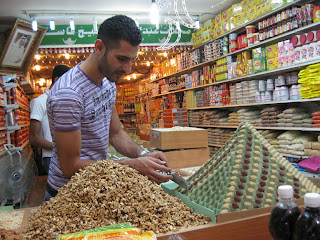
After lunch I rest for an hour and then walk to the old city to buy fabulously fresh spices my favourite shop. Kasem and Sons spice shop have everyone you might look for – and lots of spices you haven’t heard of. I leave with coriander, cumin, cinnamon, nigella and zatar for my friend Ella and a gift of a Maqlubeh blend for me.

Building a spice pyramid at Kasem & Sons

Next stop Abu Shukri for the best hummus in Jerusalem. I haven’t tried all the hummus either but again I’m not going to argue the point. Everything at Abu Shukri is sensational.

Although all day I’ve been thinking about what new restaurant I can try for dinner, by the time it rolls around I’m completely zonked and decide to ditch dinner and make up for it by having an extra meal somewhere in the Galilee – maybe in my great food meccas of Nazarateh or Rosh Pina.

Monday, August 24, 2009

Lingering Memories, and Flavours, of Bordeaux

Bon Vivant is excited to introduce its newest blogger, Carrie Brunet. Check out her profile and read on for her very first post.

As the summer sun sets in, I find myself longing for the French countryside of the Bordeaux region where, cooled by the breeze of the Atlantic ocean and intersected by the Gironde river, the weather stays a lot cooler than in large cities.

There’s a lot of reasons to love the Bordeaux region, which most people recognize for its wine. In fact, there are 57 appellations in Bordeaux, which means there are 57 varieties of wine (all of which are blended varieties using two or more types of grapes) produced in the region’s ‘chateaux’, including the highly-favoured Sauternes a sweet intense wine, perfectly paired with another regional specialty ‘salade landaise’ a salad topped with pine nuts smoked duck and foie gras.

And while I’m on the subject of food, it’s worth noting that Bordeaux has much more to offer than wine. Their regional cuisine, although not widely recognized like other French regions such as Alsace or Lyon, is incredibly diversified, with a strong penchant for local produce. These people were practicing the hundred-mile diet long before the Western Hemisphere caught on. And why not? Fresh oysters, caviar and sole are local delicacies. Producers in the area grow vegetables and fruit, and raise carefully controlled beef and lamb. Bazas beef is the most prized beef in France, grass fed and aged to create a melt-in-your mouth piece of meat. The Village of Bazas holds a festival each year as the cattle reach maturity. Now that sounds like a steak worth celebrating.

And of course, you can’t pass through Bordeaux without trying one of their signature treats—the canelés. Baked in copper molds, the pudding-like cakes have a brown crispy exterior with a soft custardy inside, often infused with cinnamon and other spices, along with a splash of rum. Street food at its best, local vendors sell these palm-sized treats for immediate consumption.

It’s been over a year since my last visit to Bordeaux but seeing this site, which details many of the local specialties has me hungering for my next gourmet getaway. But instead, I think I might surf the web for some copper molds, and create a little taste of Bordeaux in my own home.

Thursday, August 13, 2009

Old World Wines

Lire ce billet en français

Well fellow Bon Vivants – I know you’ve been waiting for it: a post all about wine! Since this is a topic we don’t take lightly here, I thought I’d go straight to our expert on the topic – Nick Keukenmeester. Not only does Nick write feature articles about wine for our magazine, Ensemble Vacations, he’s also been in the wine industry for years and has the ultimate Bon Vivant dream job as head of Private Client Sales for Lifford Wine Agency in Toronto.

Old World Wines
By Nick Keukenmeester

I often hear people complain that there are no good value European wines, but you just have to find regions and producers that are overlooked by others to find a bargain and drink like the locals (somewhere far away).

Look for southern Italy (Puglia, Sicilia, Basilicata) and red grapes you don’t know (Negroamaro, Nero d’Avola, Aglianico). You will be amazed at the concentration and it will cost less than your standard Aussie Shiraz. Or rather than drinking Barolo, drink the wines the people of Piemonte keep for themselves. Barbera is a rich, chocolatey red grape that coats the mouth with flavour. It is much less expensive and easier to drink than the average Nebbiolo-based wine from this region. Delicate whites from the Cortese (in Gavi) or Arneis grapes can also make stunning and inexpensive wines. One region that remains terribly neglected is the Douro in Portugal, the home of port. Dry table wines are now being made from port grapes such as Touriga Nacional, Tinta Roriz and many others you can’t pronounce. They are rich with fruit, have deep tannins and a great balancing acidity; worthy of the cellar or a big meal.

Lesser known areas in Spain can offer great value, too. Abadia Retuerta sits just a few miles outside the famed Ribera del Duero. It is about half the price of estates within, but their geographical misfortune is our gain. They make great Tempranillo-based wines (the noble red grape of Spain), with fruit and earthy power not associated with traditional dried-out Rioja. Neglected regions such as Toro, Rueda and Jumilla offer Monastrel (Mourvedre), Garnacha (Grenache), Tempranillo and even crisp white Verdejo wines at a fraction of their worth.

Even in France, there are excellent wines at keen prices. Look for the wines of the Languedoc-Roussillon or consider Beaujolais. This is red Burgundy, but made with the fruity and aromatic Gamay grape rather than its more admired neighbour Pinot Noir. Here grapes from great ‘cru’ such as Morgon or Fleury make wines of excellence. Elegant Beaujolais Villages can be great with or without food.

Beaujolais Villages from producers such as Louis Jadot are available in most provinces for under $20.


Tuesday, August 11, 2009

Les vins du Vieux Continent

Read this post in English

Chers bons vivants, je sais que vous attendiez un billet sur le vin, eh bien le voici! Puisque c’est un sujet que je ne prends pas à la légère, j’ai pensé me diriger tout de suite vers notre expert en la matière, Nick Keukenmeester. Nick écrit non seulement des articles sur les vins pour notre magazine, Ensemble Vacances, mais il est aussi dans l’industrie vinicole depuis des années et possède l’emploi dont tout bon vivant rêve, directeur des ventes aux particuliers pour Lifford Wine Agency à Toronto.

Les vins du Vieux Continent
Par Nick Keukenmeester

J’entends souvent les gens se plaindre de ne pouvoir trouver de bons vins européens à prix raisonnable. Pourtant, il suffit d’aller voir du côté des régions et des producteurs qui sont davantage négligés par les consommateurs d’ici pour parfois dénicher un excellent cru à prix avantageux.

Surveillez les productions du Sud de l’Italie, notamment des Pouilles, de la Sicile et de la Basilicate et les vins rouges que vous connaissez moins, comme le Negroamaro, le Nero d’Avola et l’Aglianico. Vous serez étonné par leur richesse de concentration, d’autant plus qu’ils vous coûteront moins cher que les traditionnels Shiraz d’Australie. Plutôt que de choisir un Barolo, essayez des vins de table du Piémont que les habitants du coin se réservent pour euxmêmes. Le Barbera est riche en texture, avec une pointe de saveur chocolatée très plaisante au palais. Il est beaucoup moins cher et se boit plus aisément que la moyenne des vins de cépage Nebbiolo qu’on trouve dans cette région. Les vins blancs délicats, produits avec le cépage Cortese (à Gavi) ou Arneis sont à la fois surprenants et très abordables.

Une région terriblement négligée est celle du Douro au Portugal d’où provient le porto. Ses vins de table sont réalisés à partir de cépages tels que le Touriga Nacional, le Tinta Roriz et plusieurs autres. Riches en fruit, leurs tanins sont profonds et leur acidité plutôt équilibrée. Vous pourrez facilement les conserver quelques années ou les boire sans plus attendre pour agrémenter un grand repas.

Certaines régions d’Espagne encore méconnues du grand public offrent également des vins d’excellente valeur. Le domaine Abadia Retuerta se situe à quelques kilomètres de la célèbre région vinicole de Ribera del Duero. Les vins qu’il produit se vendent à la moitié du prix de ceux qui proviennent des vignobles avoisinants, tout simplement parce qu’ils ne peuvent tirer profit de la renommée de la région voisine. Ils produisent pourtant d’excellents vins à partir du cépage Tempranillo, ce noble raisin typique à l’Espagne, fruité avec un côté végétal qu’on ne retrouve pas dans le classique Rioja. D’autres régions ignorées comme le Toro, le Rueda et le Jumilla produisent des vins de qualité à une fraction du prix de leur valeur réelle en utilisant des cépages comme le Monastrel (Mourvedre), le Garnacha (Grenache), le Tempranillo et même le Verdejo, donnant un vin blanc tout en fraîcheur.

Même en France, on trouve d’excellents vins à prix abordable. Recherchez les vins du Languedoc-Roussillon et ceux du Beaujolais, un vin rouge de Bourgogne fruité et aromatique qui est produit à partir du cépage Gamay, contrairement à ses voisins qui utilisent le Pinot Noir. Ici, les grands crus, comme le Morgon ou le Fleury se révèlent des vins d’exception. L’élégant Beaujolais Villages est aussi délectable à prendre avec ou sans repas.

On trouve un Beaujolais Villages de la maison Louis Jadot pour moins de 20 $ presque partout au Canada.

Friday, July 24, 2009

California Dreamin'

It's been a little quiet here on the Bon Vivant Travel blog, and with good reason - I was away in sunny California since Monday. I know - it's a tough life, but sometimes, you've just got to take one for the team. Now that planes, airline food and jet lag are (almost) behind me, I'm back at my post - skin a smidgen more tanned, smile a lot wider.


Those few days away were quite a whirlwind, and luckily, great food made it on the agenda. On my first night, I had the pleasure of dining at the Second City Bistro in El Segundo. I often have diner's envy when I'm eating out with others - you know, you order something, thinking it will good, and it is, but you can't help but wonder if your dining companion's meal might just be a bit tastier than yours. That wasn't a problem that night. I started with the tomato, basil and gorgonzola bisque, and that would have been worth the trip for me. It was fantastic, so much so that I ate it quickly and quietly so that the others wouldn't catch on to the tastiness of it all and ask me to, gulp, share. The rest of the meal was great too - a nicoise salad with seared rare ahi, and for dessert - sorbet! I know I've professed my love for lemon gelato, but coconut sorbet is closing in fast and might find its way to top position on the frozen treats podium.

One aspect of California's culinary scene that I wish I would have had more time for is the wine. There is a lot to explore in California's wine region, and I'm itching for a chance to explore it the next time I'm out there. But until then, I have my trusty mouse to help me soak it all in virtually. If you care to join me, grab a glass of vino and check out this link - all about the best the region has to offer. If you're already set to go, Globus might just already have the perfect itinerary for you. Their California Wine Country tour takes you to all the key spots and then some. Wine tasting and olive oil tasting? Yup - I'm there. Well, in my dreams anyway.
Related Posts with Thumbnails